Why You Need To Send Your Kids For Yoga Class Now

Not just about physical balance, yoga helps kids centre their focus and makes them more connected and self-aware. The result: A happier, healthier child.

A hyperactive or anxious child can drive even the most patient parent batty and feel less than equipped to handle tantrums or sullen behaviour. Cut yourself some slack. It’s human to get exasperated but there’s an effective way to help your child settle down. Here’s where yoga comes in. Just like how it can give inner calm to adults and help them achieve better balance and self-awareness, it’s great for little ones too.

Kids need a way to manage stress and anxiety. “Yoga helps them cope with the challenges they face, especially in today’s test-driven world”, says Jolie Michelle Ow, founder and programme director at CANVASS. There’s the actual physical activity that keeps young bodies strong, limber and graceful; and there’s the calming effect on children because the practise makes them more connected and aware overall. “The physical poses and sequences teach balance, and balance is about focus and concentration. Thus the grounding lesson stretches beyond the body, and extends to the mind and emotions,” she explains.

The goal is to “develop wellness through self-awareness”, she says. Practising yoga helps to “increase a child’s attention span. It helps them focus their thoughts. It enables them to connect deeper with their emotions and with that better understanding, they become more articulate in their expressions. More importantly, they learn a stress-management tool they can use for life,” she adds.

Children of course have a better learning curve when lessons are taught through play, and that’s key in the teaching process at CANVASS. “We want kids to have loads of fun even when they are learning life-long skills. We encourage play, but it is a purposeful play that embraces reflection and practise,” she shares.

She believes that it’s never too early to start your little ones on yoga as it benefits kids of all ages, sizes and temperaments. In fact the Children’s Yoga class at CANVASS are geared for kids from age five to 13. The age variance is actually advantageous and helps to develop the children’s social skills. Jolie Michelle explains: “It teaches acceptance and appreciation of different body shapes and sizes; and that both young and old can learn from one another.”   

While classical yoga is still the preferred teaching at CANVASS, the poses in Children’s Yoga are geared for kids, the sequences taught through creative games. The fun begins the minute class starts. For example, children learn to use their bodies to express their state of emotions. Putting their hands on the ears says “I am focused”; hands-to-heart says “I am peaceful”; and hands-on-knees while sitting cross-legged says “I am calm”.

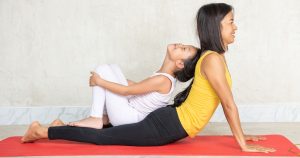
Another example: They learn about connection and courage through partner poses. “You need to trust that your partner won’t let go and let you fall. You surrender in good faith and learn team skills in a safe, nurturing environment,” explains Jolie Michelle. The children also get to explore shapes and spaces, again through their bodies. By bending down and leaning forward, the body forms a triangle; stand tall with your hands raised and outstretched, another shape is formed.

Visualisation has a two-fold benefit. It helps kids to improve on their poses. More importantly though it helps them focus inward on their self and takes away the judgements (from others) about how you look. Instead you become more attuned to your strengths and what the body is capable of doing, regardless of size. “We teach them to be happier inside their bodies, and at the same time they learn the CANVASS values of compassion, forgiveness and empathy,” she adds.

The kids have most fun however doing improvised poses. “We encourage children to use the poses they’ve learnt and come up with their own sequence – usually exploring three or four poses that make them feel good about themselves. Like lyrical dance, it’s a creative flow of personal expression through yoga poses.

“But it’s not just all movement and games. We also explore stillness and silence to deepen their awareness and slow them down so they can focus their minds. This promotes better clarity and peace,” says Jolie Michelle. A game of monkey-see-monkey-do for example, does away with words and focuses on actions instead, to get them comfortable with silence. Breathing techniques, relaxation exercises and simple meditation are taught, so the children have more energy to perform and have better concentration. “They learn: I am here, and I am present,” she adds.   

There are indeed many pull factors for kids to pick up yoga. Fitness, flexibility, strength-training, better motor skills – these just only just scratch the surface. As every parent knows and desires, the end objective is really to have a happier, healthier and less stressed child.  Ultimately, a good children’s yoga class, says Jolie Michelle, should make the little ones feel more connected and loved; their bodies and minds more at ease and in equilibrium. She puts it across succinctly: “In play we find balance; and with balance, we rise with grace. “
Share this post:

DOES YOUR SOUL NEED A VACATION? OR IS IT LONGING FOR A PILGRIMAGE?

CANVASS Nepal 2026 Overview The Pilgrimage The Experience Investment & Register Nepal Videos Nepal Article Hamburger Toggle Menu DOES YOUR SOUL NEED A VACATION? OR IS IT LONGING FOR A PILGRIMAGE? A CALL TO TRAVEL DIFFERENTLY There comes a point when another holiday no longer feels like enough. The destination may be beautiful. The food memorable. The photographs stunning. Yet something deeper continues to call. Not for escape, but for meaning. Not for another place to visit, but for a different way of travelling. Perhaps what the soul is seeking is not a vacation. Perhaps it is seeking a pilgrimage. WHY SACRED TRAVEL IS DIFFERENT Most travel is designed to help us see more. Pilgrimage invites us to feel more. It asks us to slow down, pay attention, and enter into a deeper relationship with place, people, culture, and ourselves. Rather than moving quickly from one attraction to the next, pilgrimage invites us to travel with intention. To listen, to observe, and become students again. The destination matters, but the journey itself becomes the teacher. A sacred journey is not about collecting experiences. It is about allowing experiences to shape us. TRAVEL AS A PATH OF REMEMBERANCE For thousands of years, people have walked sacred paths seeking wisdom, blessings, clarity, healing, and understanding.Yet often the greatest gift of pilgrimage is not what we discover.It is what we remember.When we step away from our routines and distractions, something begins to soften. We reconnect with qualities that modern life often asks us to neglect: presence, wonder, humility, gratitude, stillness, and reflection. Pilgrimage reminds us that life is not only about achievement and productivity. It is also about meaning, relationship, and remembering what truly matters. WHY NEPAL? I have travelled to many places, yet there is something about Nepal that keeps calling me back.People travel from around the world to stand before Mount Everest, the highest mountain on Earth. Yet beyond its majestic peaks lies another kind of treasure. Nestled between India and Tibet and embraced by the Himalayas, Nepal has long been a meeting place of sacred traditions, pilgrimage routes, monasteries, temples, meditation lineages, and spiritual seekers. It is the birthplace of the Buddha and home to places where masters, yogis, monks, and practitioners have spent centuries in retreat, contemplation, and prayer. What fascinates me most is that many of Nepal’s greatest treasures are hidden in plain sight. Not only in its mountains and monuments, but in its stories, traditions, prayers, and living wisdom. HIDDEN TREASURES AND SACRED WISDOMS Many visitors walk through Nepal’s sacred sites without fully understanding what lies beneath them. Places such as Swayambhunath and Boudhanath are far more than beautiful UNESCO heritage sites. They are living centres of pilgrimage, devotion, prayer, and spiritual practice. Within them are sacred symbols, relics, blessings, teachings, and stories accumulated through centuries of human aspiration. In Pharping, we will visit sacred caves where Guru Padmasambhava (Guru Rinpoche) is believed to have meditated and attained profound realisations before bringing Buddhism to Tibet. When we begin to understand the stories, symbolism, and traditions held within these sacred lands, the experience changes completely. We are no longer simply visiting a place.We are entering into a living conversation that has been unfolding for centuries, and discovering what it may have to teach us today. SAFE ENOUGH TO SOFTEN Pilgrimage often reveals that the most meaningful transformation is not external.It is internal. As we walk through forests, temples, mountains, monasteries, and villages, we begin to notice what is happening within ourselves. Questions emerge. Perspectives shift. Old stories soften. New possibilities appear. What once felt urgent may no longer matter. What once felt hidden may become clear. Throughout our journey, we will walk sacred kora paths, visit ancient sites, spend time in nature, learn from local wisdom keepers, and engage in practices that cultivate greater clarity, perspective, and presence. These experiences are not about fixing ourselves. They are invitations to become more aware, more receptive, and more aligned with what life may be asking of us. RETURNING TO WHAT MATTERS More than twenty years ago, I travelled to Nepal as part of a charity project in a rural village. I arrived believing we were bringing something valuable to the children. Instead, they changed me. Years later, I still keep the letters they wrote to me. They remind me that what transforms lives is not always money, resources, or solutions. More often, it is presence, connection, and care. That experience shaped how I see the world, and perhaps why I keep returning to Nepal. Not because it gives me answers, but because it helps me remember what truly matters. Read my personal reflection: Why I Keep Returning to Nepal → WHY I KEEP RETURNING Almost every year, I return to Nepal. Not simply as a destination, but as a place of retreat and pilgrimage.In a world that asks us to move faster, consume more, and constantly strive for what comes next, pilgrimage offers another way. A chance to slow down, walk with intention, and reconnect with the wisdom found in sacred landscapes, ancient traditions, and meaningful conversations. Together, we will walk ancient paths, uncover hidden wisdoms, and discover sacred treasures—both around us and within us. Not in search of more, but in remembrance of what truly matters. Perhaps what you are seeking is not another vacation, but a pilgrimage. wATCH vIDEOS Come Walk With Me Nepal 2026 Overview The Pilgrimage The Experience Investment & Register Nepal Videos Nepal Article Hamburger Toggle Menu What We Journey Through Grounding & Presence Daily meditation and silent reflection Mindfulness in movement and stillness Healing & Energy Alignment Reiki-based practices and energy work Nervous system restoration through guided deep meditation and visualisation Mantra, Sound & Inner Resonance Daily mantra recitation to align with intention and purpose Himalayan sound healing to harmonise and deepen your personal journey Somatic + Align Flow Yoga, Qigong, and aligned movement Reconnecting breath, body, and awareness with your inner compass Expression & Integration Journaling and reflective inquiry Therapeutic art for

Read More »

Why You Need To Send Your Kids For Yoga Class Now

Not just about physical balance, yoga helps kids centre their focus and makes them more connected and self-aware. The result: A happier, healthier child. A hyperactive or anxious child can drive even the most patient parent batty and feel less than equipped to handle tantrums or sullen behaviour. Cut yourself some slack. It’s human to get exasperated but there’s an effective way to help your child settle down. Here’s where yoga comes in. Just like how it can give inner calm to adults and help them achieve better balance and self-awareness, it’s great for little ones too. Kids need a way to manage stress and anxiety. “Yoga helps them cope with the challenges they face, especially in today’s test-driven world”, says Jolie Michelle Ow, founder and programme director at CANVASS. There’s the actual physical activity that keeps young bodies strong, limber and graceful; and there’s the calming effect on children because the practise makes them more connected and aware overall. “The physical poses and sequences teach balance, and balance is about focus and concentration. Thus the grounding lesson stretches beyond the body, and extends to the mind and emotions,” she explains. The goal is to “develop wellness through self-awareness”, she says. Practising yoga helps to “increase a child’s attention span. It helps them focus their thoughts. It enables them to connect deeper with their emotions and with that better understanding, they become more articulate in their expressions. More importantly, they learn a stress-management tool they can use for life,” she adds. Children of course have a better learning curve when lessons are taught through play, and that’s key in the teaching process at CANVASS. “We want kids to have loads of fun even when they are learning life-long skills. We encourage play, but it is a purposeful play that embraces reflection and practise,” she shares. She believes that it’s never too early to start your little ones on yoga as it benefits kids of all ages, sizes and temperaments. In fact the Children’s Yoga class at CANVASS are geared for kids from age five to 13. The age variance is actually advantageous and helps to develop the children’s social skills. Jolie Michelle explains: “It teaches acceptance and appreciation of different body shapes and sizes; and that both young and old can learn from one another.”    While classical yoga is still the preferred teaching at CANVASS, the poses in Children’s Yoga are geared for kids, the sequences taught through creative games. The fun begins the minute class starts. For example, children learn to use their bodies to express their state of emotions. Putting their hands on the ears says “I am focused”; hands-to-heart says “I am peaceful”; and hands-on-knees while sitting cross-legged says “I am calm”. Another example: They learn about connection and courage through partner poses. “You need to trust that your partner won’t let go and let you fall. You surrender in good faith and learn team skills in a safe, nurturing environment,” explains Jolie Michelle. The children also get to explore shapes and spaces, again through their bodies. By bending down and leaning forward, the body forms a triangle; stand tall with your hands raised and outstretched, another shape is formed. Visualisation has a two-fold benefit. It helps kids to improve on their poses. More importantly though it helps them focus inward on their self and takes away the judgements (from others) about how you look. Instead you become more attuned to your strengths and what the body is capable of doing, regardless of size. “We teach them to be happier inside their bodies, and at the same time they learn the CANVASS values of compassion, forgiveness and empathy,” she adds. The kids have most fun however doing improvised poses. “We encourage children to use the poses they’ve learnt and come up with their own sequence – usually exploring three or four poses that make them feel good about themselves. Like lyrical dance, it’s a creative flow of personal expression through yoga poses. “But it’s not just all movement and games. We also explore stillness and silence to deepen their awareness and slow them down so they can focus their minds. This promotes better clarity and peace,” says Jolie Michelle. A game of monkey-see-monkey-do for example, does away with words and focuses on actions instead, to get them comfortable with silence. Breathing techniques, relaxation exercises and simple meditation are taught, so the children have more energy to perform and have better concentration. “They learn: I am here, and I am present,” she adds.    There are indeed many pull factors for kids to pick up yoga. Fitness, flexibility, strength-training, better motor skills – these just only just scratch the surface. As every parent knows and desires, the end objective is really to have a happier, healthier and less stressed child.  Ultimately, a good children’s yoga class, says Jolie Michelle, should make the little ones feel more connected and loved; their bodies and minds more at ease and in equilibrium. She puts it across succinctly: “In play we find balance; and with balance, we rise with grace. “

Read More »